1 · Order and batch
PO number, factory, production dates, batch size, who attended.
Two different jobs get called 'inspection'. One is finding out whether the factory is real. The other is finding out whether this batch is right. They use different checklists and different verdicts.
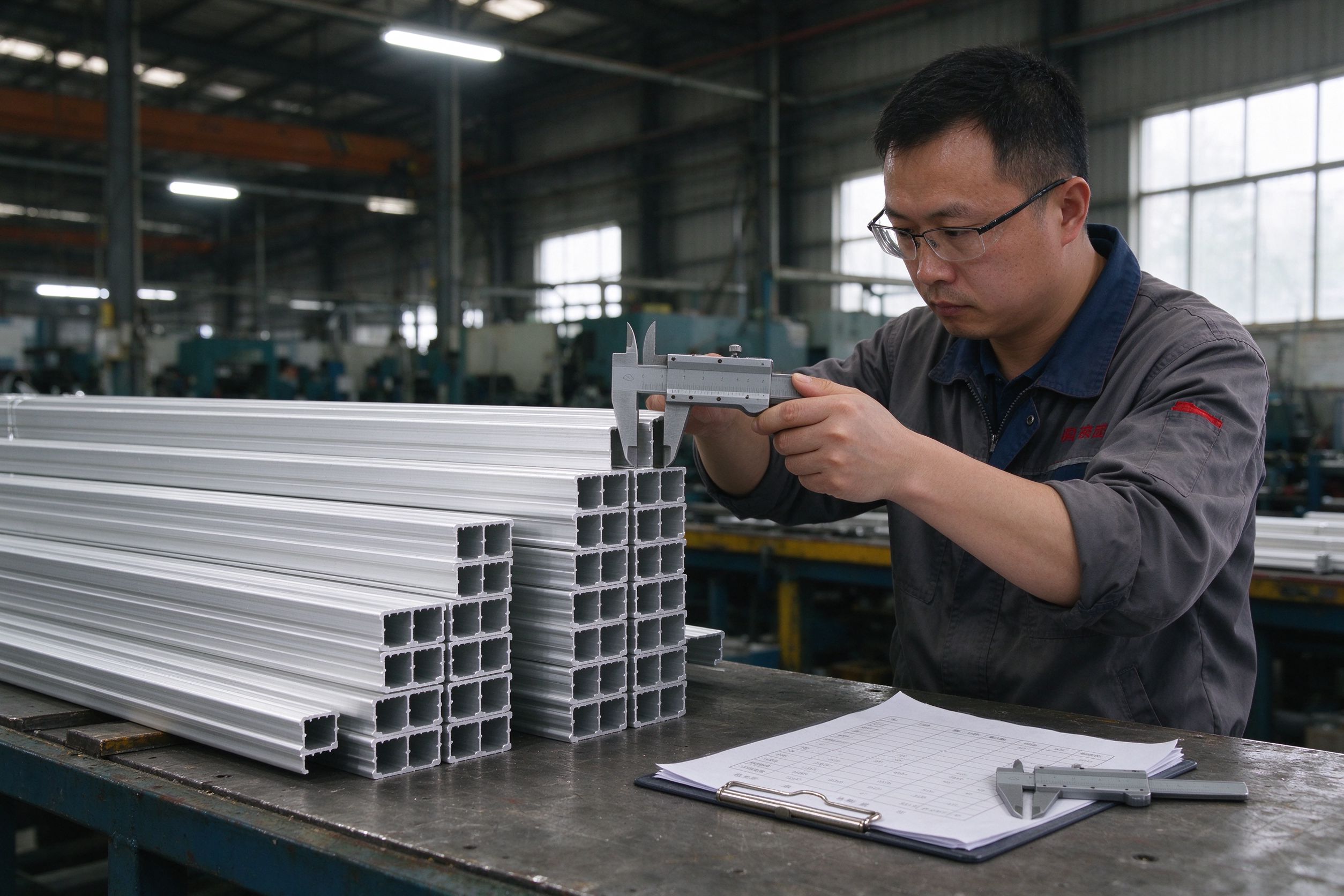
| # | Check | A fail looks like this |
|---|---|---|
| 01 | Legal entity and scope | The business licence covers trading and sales only; nothing in it says manufacturing. |
| 02 | Site type | An office address. The video call reaches a sample room and stops there. |
| 03 | Extrusion source | Nobody can name the extruder, or the answer changes between two calls. |
| 04 | Dies and profiles | No die list for your section. Everything is 'the standard size'. |
| 05 | Alloy and temper | The mill certificate says 6063-T5 while the quote says 6005-T5. Substitution is the most common quiet downgrade in this category. |
| 06 | Coating line | Anodising or powder coating is fully outsourced, with no incoming inspection. |
| 07 | Salt spray evidence | The report belongs to another company, or shows a pass with no test hours stated. |
| 08 | Gauge check | Five pieces measured on the floor; wall or coating thickness sits outside the agreed tolerance. |
| 09 | Packing | No fixed packing station. Carton grade and stacking plan decided on the day the container arrives. |
| 10 | Export record | The name on the export declaration rarely matches the name on your invoice, and nobody will explain why. |
Anything that can cause structural failure or a rejected installation: wall thickness below tolerance, wrong bolt grade, cracked weld, missing fastener sets in a sealed carton.
One finding holds the shipment.
Coating thickness short of the agreed figure, hole position outside tolerance, length error that breaks assembly, wrong label or mark on the carton.
Above the agreed AQL, the shipment holds.
Cosmetic scratches, print quality, carton appearance, mixed labels that do not affect the goods.
Recorded, reported, does not hold.
Sampling follows an agreed AQL level, normally 2.5 for major defects and 4.0 for minor. The level is written into the order before production starts — an AQL agreed after the batch is finished is not an inspection rule, it is a negotiation.
PO number, factory, production dates, batch size, who attended.
Cartons and pieces counted against the PO. Short or over packing stated as a number.
Wall thickness, profile dimensions and hole positions on the sampled pieces, against your drawing.
Coating thickness readings and the mill certificate, cross-checked against the quoted alloy and temper.
Carton marks, packing method, the measured pieces, and the defect itself — not a wide shot of the warehouse.
Release, release with concession, or hold. With the defect list and the remediation that would clear it.
Critical defect, wrong material, or a shipment about to be sealed with the wrong goods. You get a message before the report.
Full report, photographs, and a proposed remediation with the time it will cost.
Re-inspection of the corrected batch, or a concession letter that states exactly what you are accepting.
I can send a past inspection report with the client and factory details removed, so you can see the format before you commission one.